
Restoration
Permanently fixed prosthesis
Restoration
Single tooth loss
The implant takes over the function of the tooth root and transfers the chewing force to the jawbone. The jawbone remains vital through this natural loading and does not recede.
A new tooth should not only fulfil its function, but especially in the anterior region, be indistinguishable from natural teeth. An aesthetically pleasing treatment result is particularly important here. Fixed, implant-supported teeth not only look like your own, but also feel like them. Implant, new tooth and soft tissue form a harmonious unit.
Partial dentition
When several teeth are lost, the chewing forces are no longer transferred evenly into the bone. Bone loss due to missing or incorrect loading can be the consequence. The resulting gap should be closed from both a medical and aesthetic perspective.
Implants enable the restoration of natural chewing conditions and prevent bone loss. How many implants are used for a patient depends on their bone quality, the number of missing teeth and the chosen prosthetic solution.
Edentulous jaw
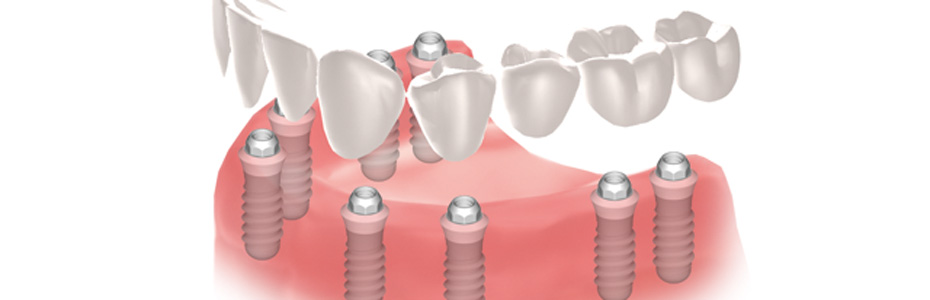
Even in cases of total tooth loss, implants enable an aesthetic and fixed restoration. With regard to wearing comfort and quality of life, an implant-anchored, removable prosthesis is the therapy of first choice. Patients with an edentulous jaw have two options to choose from: a fixed dental arch screwed onto implants or a removable, implant-supported prosthesis.
Removable, implant-supported prostheses do not slip and prevent pressure sores. They sit firmly on their abutments, the implants.
Permanently fixed dental arches are the more aesthetically demanding solution. This treatment option is characterised by high wearing comfort and a more natural appearance.
With both options, patients are spared the disadvantages of a conventional prosthesis such as pressure sores, slipping and pain when chewing.
Das Wichtigste auf einen Blick
- Bei Einzelzahnverlust übernimmt das Implantat die Funktion der Zahnwurzel und leitet die Kaukraft an den Kieferknochen weiter.
- Bei mehreren fehlenden Zähnen ermöglichen Implantate die Wiederherstellung der natürlichen Kauverhältnisse.
- Bei zahnlosem Kiefer stehen eine fest verschraubte Zahnreihe oder eine herausnehmbare, implantatgetragene Prothese zur Wahl.
- Die Anzahl der benötigten Implantate hängt von Knochenqualität und Anzahl der fehlenden Zähne ab.