
Bone Augmentation
When teeth are lost, the body breaks down the bone that is no longer subjected to loading.
Bone Augmentation
When teeth are lost, the body breaks down the bone that is no longer subjected to loading. Sufficient bone volume must be available for implantation. Even patients who have lost bone after prolonged edentulism can be helped. A bone deficit can be compensated by an additional procedure in which harvested autogenous bone is transplanted. After healing, this autogenous tissue forms a stable foundation for the implants.
A smaller bone deficit can be filled with bone substitute materials. During implantation, a defect is filled with bone substitute material. Often, bone chips are mixed in. The surgical site is protected with a membrane.
Autogenous bone
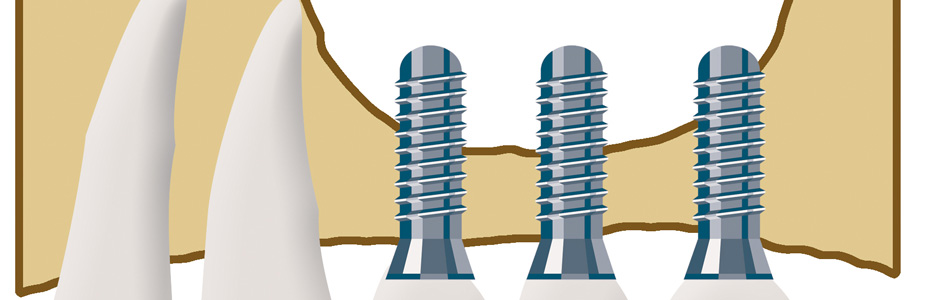
Jaws that are too narrow, flat (jaw ridges) or atrophied jaw areas can be built up using harvested autogenous bone. The harvested bone is fixed with special screws and typically needs several months to heal. During this time, the new bone is covered with a membrane so that stable bone substance can form. Only then are the implants placed.
In cases of major bone deficit, bone augmentation is performed by harvesting autogenous tissue. Smaller bone blocks can be harvested from the lower jaw, chin or wisdom tooth area and placed directly. For larger bone harvesting, this is performed in an additional procedure from the iliac crest.
Das Wichtigste auf einen Blick
- Nach Zahnverlust kann sich der nicht mehr belastete Kieferknochen zurückbilden.
- Für eine Implantation ist ausreichendes Knochenvolumen erforderlich.
- Kleinere Knochendefizite lassen sich mit Knochenersatzmaterial auffüllen, größere durch Eigenknochentransplantation.
- Eigenknochen kann je nach Bedarf aus dem Kieferbereich oder dem Beckenkamm entnommen werden.